How it works
COMMONTARY’s double-patented technology lets viewers create or listen to an alternate audio source, delivered in real time and synced to their own video feed.
The problem being solved
Two people watching the same live event are almost never at the same moment of it. Cable, satellite and each streaming service introduce their own delay, and viewers pause, rewind, and drift. A commentary track that is right for one viewer is seconds — sometimes half a minute — wrong for the next.
The obvious fix is to have the broadcaster hand out a timecode. That requires their cooperation, their engineering time, and a separate integration with every service carrying the event. It's why alternate audio has historically only existed where a network built it deliberately.
What COMMONTARY does instead
It listens.
- Fingerprint the broadcast. The audio of the source broadcast is analyzed into a stream of compact, distinctive signatures — a fingerprint of the sound at each moment.
- Fingerprint what the viewer is hearing. The app samples the audio reaching the viewer, from their own device or from a television across the room, and fingerprints that the same way.
- Match the two. Comparing the fingerprints establishes exactly where in the broadcast that particular viewer is, to within a fraction of a second.
- Deliver the alternate audio at that offset. The commentary stream is played from the matching position, so it lands on the viewer’s moment rather than on the broadcaster’s.
Because sync is derived from the sound itself, nothing has to be requested from the broadcaster: no timecode, no stream access, no integration into their delivery chain. It works on whatever service the viewer happens to be using, and it works on a television that has no idea COMMONTARY exists.
The same mechanism scales sideways. One broadcast can carry one alternate feed or thousands, because each listener is synced independently against the same fingerprints.
Broadcaster use case
A broadcaster, league, or platform originates the alternate feeds. Talent calls the event from anywhere, the audio is fingerprint-synced against the broadcast, and viewers select a feed from inside an app — the platform’s own, or a white-labeled one. This is the path that adds audience segments and sponsorship inventory to content the partner already owns.
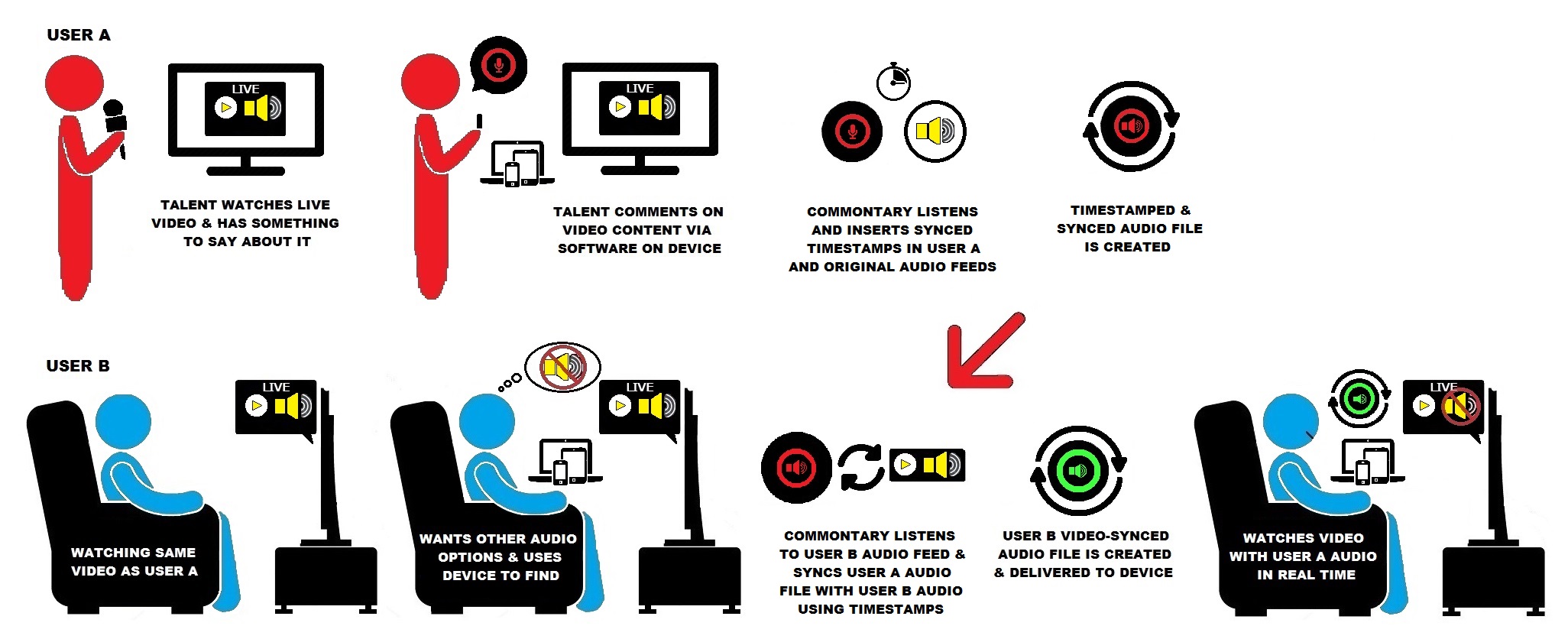
User-generated content use case
The same technology, opened up. A creator records straight from the COMMONTARY app while watching the event themselves. Their feed is fingerprint-synced exactly as a broadcaster’s would be, and their audience finds it in the app and listens along on whatever service they are watching. No production infrastructure, and no rights negotiation, because nothing from the original broadcast is retransmitted.
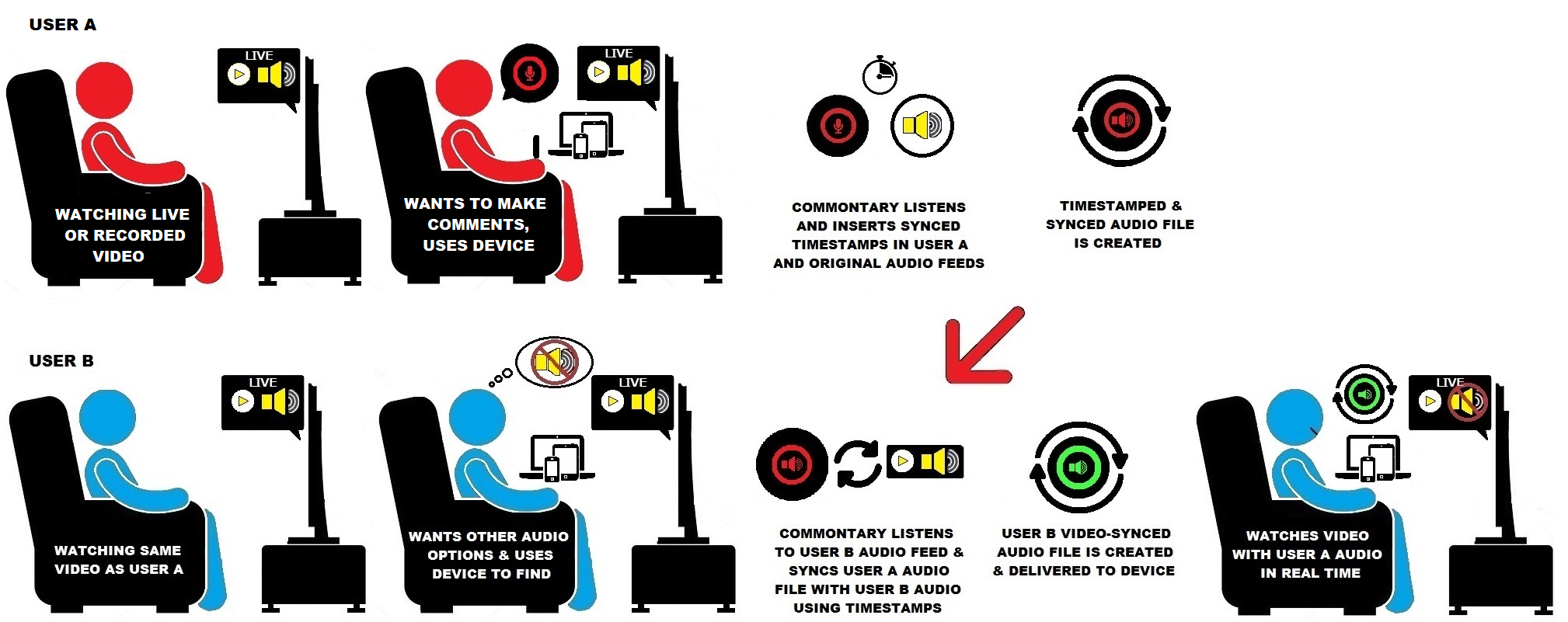
The patents
The synchronization method is covered by two granted U.S. patents, both assigned to MyTeamCalls LLC. Patents & IP